
50 Synonyms for During: Meanings, Examples, and How to Use Them in 2026
The word “during” is common in everyday English. We use it to explain when something happens, such as during a meeting, during the summer, or during a school lesson. However, repeating the same word too often can make writing sound less natural.
Learning synonyms for during can help you express time, describe events, and connect ideas more clearly. Depending on the sentence, you might use words such as while, throughout, amid, over, or within. You can also use phrases such as in the course of, at the same time as, and for the duration of.
However, these alternatives do not all mean exactly the same thing. Some describe an action that happens at the same time as another action, while others refer to an entire period or a specific moment.
This guide explains 50 alternatives to during, including their meanings, practical examples, differences, and common usage mistakes. It is designed for students, teachers, bloggers, professionals, and anyone who wants to improve their English vocabulary.
What Is the Synonym of During?
The best synonym for during depends on the context of your sentence.
During is a preposition that generally means at some point within a period or throughout a particular event or time. For example, “She took notes during the lecture” means that she took notes while the lecture was happening.
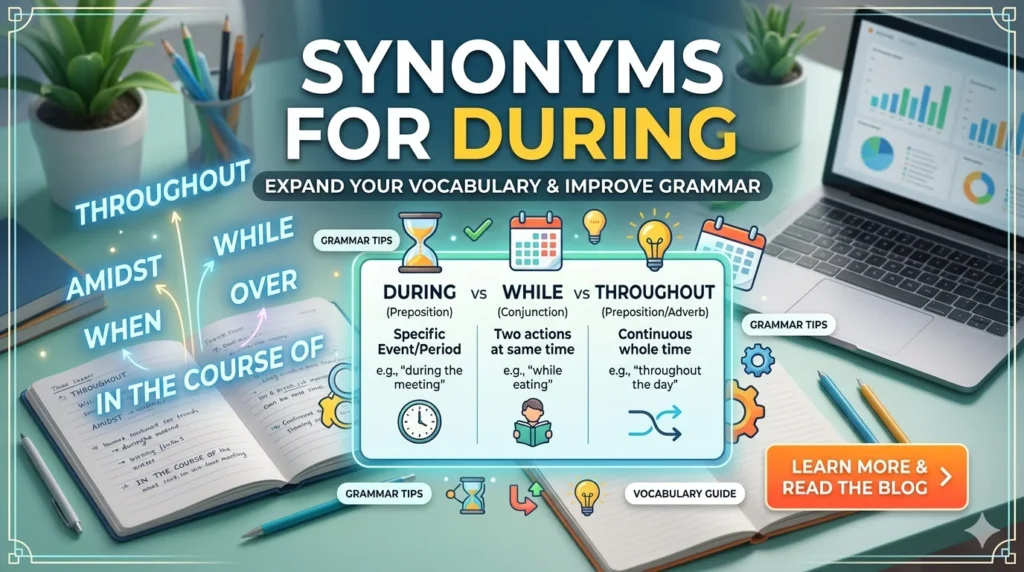
Common alternatives include:
- While — when two actions happen at the same time.
- Throughout — when something continues across an entire period.
- Amid — when something happens in the middle of a situation.
- Over — when describing changes or activities across a period.
- In the course of — a formal phrase referring to the time when something happens.
- In the middle of — when something happens while an activity is already underway.
- Throughout the period — when emphasizing an entire time span.
- At the time of — when referring to a particular event or moment.
For example:
Original: The students remained quiet during the examination.
Alternative: The students remained quiet throughout the examination.
The second sentence emphasizes that the students stayed quiet for the entire examination. The best replacement is the one that preserves the original meaning.
50 Synonyms for During With Meanings and Examples
The following alternatives include single words, prepositions, conjunctions, and expressions related to time. Some are direct replacements for during, while others work only in particular sentence structures.
1. While
Meaning: At the same time that something else happens.
Example: Maria listened carefully while the teacher explained the lesson.
Use while when describing two actions that happen together. Unlike during, it can introduce a complete clause containing a subject and a verb.
2. Throughout
Meaning: From the beginning to the end of a period or across all parts of it.
Example: The team remained focused throughout the competition.
Throughout is especially useful when you want to emphasize that an action continued for the whole event.
3. Amid
Meaning: In the middle of a situation, activity, or set of circumstances.
Example: The volunteers continued their work amid the confusion.
Amid often appears in formal writing, news reports, and descriptions of difficult situations.
4. Amidst
Meaning: Surrounded by or in the middle of something.
Example: She found moments of peace amidst the busy schedule.
Amidst has essentially the same meaning as amid. It can sound slightly more literary, although both forms are correct.
5. Over
Meaning: Across a period of time.
Example: His writing skills improved over the summer.
Over is useful when discussing development, change, progress, or activities that take place across a period.
6. Through
Meaning: From one point to another, including across a period.
Example: The nurse monitored the patient through the night.
Through can suggest that an activity continued during a period, especially when the period was long or difficult.
7. In the course of
Meaning: While something is happening or as part of a process.
Example: We discovered several useful ideas in the course of our research.
This phrase is suitable for academic writing, business reports, and detailed explanations.
8. In the middle of
Meaning: While an activity or event is already happening.
Example: The phone rang in the middle of dinner.
Use this expression when an event occurs partway through another activity or interrupts it.
Also Read: Morocco Group Tours: Combining Desert, Mountains, and Culture in One Trip
9. At the time of
Meaning: At the moment or period when a particular event occurs.
Example: She was living in Chicago at the time of the accident.
This phrase is useful when referring to a specific historical event, incident, or moment.
10. During the course of
Meaning: At some point or across the period in which something happens.
Example: Several questions came up during the course of the discussion.
This expression is similar to in the course of, but it explicitly identifies the period or activity being discussed.
11. In
Meaning: Within a particular period or setting, depending on the context.
Example: We learned several new techniques in the workshop.
In is a natural choice when referring to an activity, event, or setting. However, it does not replace during in every sentence.
12. At
Meaning: At a particular time or event.
Example: We discussed the new schedule at lunch.
At works when the sentence refers to an event or time point. It usually does not emphasize the full duration of an activity.
13. Within
Meaning: Before a specified period ends or inside a particular limit.
Example: Please submit the application within five days.
Within is often confused with during. It usually emphasizes a deadline or time limit rather than simply stating that something happens during a period.
14. Pending
Meaning: While waiting for a decision, result, or another event.
Example: The application remains under review pending a final decision.
Pending is mainly used in formal and administrative contexts. It is not a general replacement for during.
15. Meanwhile
Meaning: During the same general period, while another activity happens.
Example: Daniel prepared dinner. Meanwhile, his sister set the table.
Meanwhile is useful for connecting related events in stories and explanations. It generally functions as an adverb rather than a direct substitute for during.
16. Simultaneously
Meaning: Happening at exactly the same time or at overlapping times.
Example: Two teams worked simultaneously on different parts of the project.
This word emphasizes timing between actions rather than the duration of a single event.
17. Concurrently
Meaning: Happening or existing at the same time as something else.
Example: The company developed two products concurrently.
Concurrently is common in technical, professional, and academic writing.
18. At the same time as
Meaning: During the period when another event happens.
Example: The power went out at the same time as the storm began.
This phrase makes the relationship between two events clear. It can indicate simultaneous timing rather than an entire period.
19. Whilst
Meaning: At the same time that something happens.
Example: She took notes whilst listening to the presentation.
Whilst is commonly associated with British English. While is generally the more familiar choice in American English.
20. As
Meaning: While or when an action happens, depending on the sentence.
Example: As the meeting progressed, the team became more confident.
As can express timing, but it has other meanings, including because and in the role of. Choose it carefully to avoid ambiguity.
21. As
Meaning: During the process of an action or change.
Example: As the sun rose, the temperature began to increase.
In this sentence, as connects two events that develop at roughly the same time.
22. For the duration of
Meaning: For the entire length of a particular event or period.
Example: Visitors must remain in the designated area for the duration of the tour.
This expression is useful for rules, instructions, policies, and formal notices.
23. All through
Meaning: Across an entire period, from start to finish.
Example: The children talked excitedly all through the journey.
All through is more conversational than throughout but communicates a similar idea.
24. Over the course of
Meaning: Across a period in which changes or events take place.
Example: The business expanded over the course of three years.
This phrase is particularly useful for describing gradual progress, development, and long-term change.
25. In the span of
Meaning: Within a particular length of time.
Example: She learned the basic skills in the span of a few weeks.
In the span of emphasizes the length of the period. It is especially useful when highlighting how quickly something happened.
26. In between
Meaning: In the intervals separating two activities, events, or points in time.
Example: He reviewed his notes in between classes.
In between usually describes gaps rather than the full duration of an event, so it is not always interchangeable with during.
27. Along the way
Meaning: At different points during a process or journey.
Example: We made several helpful discoveries along the way.
This expression is useful when discussing learning, personal development, projects, and journeys.
28. As part of
Meaning: Within a larger activity, plan, or process.
Example: Students completed a short quiz as part of the lesson.
As part of emphasizes that something belongs to a broader activity rather than simply happening at the same time.
29. In the process of
Meaning: While carrying out an activity or completing a task.
Example: The researcher identified a problem in the process of reviewing the data.
This phrase is useful when the focus is on work or an activity that is underway.
30. In the midst of
Meaning: In the middle of an event, activity, or situation.
Example: The manager received an urgent call in the midst of a presentation.
In the midst of often emphasizes that something occurs while another activity is already underway.
31. Amid the course of
Meaning: This is an uncommon and generally unnatural combination when intended to mean during.
Example of a better expression: Several issues arose in the course of the investigation.
Although amid and in the course of are both useful expressions, combining them this way is usually unnecessary. Choose the phrase that fits the intended meaning.
32. Across
Meaning: Over a range of time, places, or situations.
Example: The policy changed across several months of discussion.
Across is possible in some time-related contexts, but over or throughout is often more natural when referring to a period.
33. Between
Meaning: Within an interval separating two points or events.
Example: The office remained busy between the morning and afternoon sessions.
Between is useful when the time period has identifiable boundaries. It is not a general substitute for during.
34. Until
Meaning: Up to the time when an event or condition ends.
Example: She continued working until the meeting finished.
Until focuses on an endpoint. It may describe part of a period covered by during, but it does not have the same meaning.
35. As soon as
Meaning: Immediately after or at the moment something happens.
Example: As soon as the class ended, the students left the room.
This expression describes a transition between events rather than an activity occurring throughout a period.
36. Whenever
Meaning: Every time or at any time that something happens.
Example: Whenever the teacher asked a question, the students raised their hands.
Whenever is useful for repeated or recurring situations, not as a universal synonym for during.
37. When
Meaning: At the time that an event happens.
Example: When the lights went out, everyone stopped talking.
When can sometimes replace during a particular activity if the sentence is restructured.
38. As long as
Meaning: For the period that a condition continues.
Example: You may use the room as long as the workshop is in progress.
As long as often expresses a condition as well as duration. It should not replace during when the sentence does not contain that relationship.
39. For
Meaning: Throughout a stated length of time.
Example: She practiced the piano for two hours.
For indicates duration, whereas during identifies the period in which something happens.
40. Throughout the period
Meaning: Across the entire specified time frame.
Example: The service remained available throughout the period of maintenance.
This phrase works well in reports, formal explanations, and descriptions of extended activities.
41. Throughout the event
Meaning: From the start of an event to its conclusion.
Example: Security staff remained on duty throughout the event.
Use this expression when you want to emphasize that something continued for the whole event.
42. Throughout the day
Meaning: Across the entire day.
Example: Temperatures remained high throughout the day.
This phrase is suitable for weather reports, daily schedules, and descriptions of activities that continue for many hours.
43. Throughout the night
Meaning: For the whole night.
Example: Emergency workers stayed at the site throughout the night.
This expression highlights continuous activity or a condition that lasts from evening until morning.
44. During the same period
Meaning: Within a time frame that overlaps with another period.
Example: The company opened two new offices during the same period.
This phrase is useful when comparing events, projects, or changes that happened within overlapping time frames.
45. At intervals during
Meaning: At separate points within a period.
Example: The guide stopped at intervals during the hike to explain the local wildlife.
This expression is helpful when an action happens occasionally rather than continuously.
46. At various points during
Meaning: At several different moments within a period.
Example: At various points during the interview, the candidate discussed her previous experience.
This phrase is appropriate when the action occurs more than once but not necessarily throughout the entire event.
47. In the course of time
Meaning: As time passes or as a process develops.
Example: In the course of time, the team developed a more effective approach.
This expression often suggests gradual change. Depending on the sentence, over time may sound more natural.
48. Over time
Meaning: Gradually as time passes.
Example: Regular practice helped him become more confident over time.
Over time is an excellent choice for discussing learning, improvement, development, and change.
49. For the whole of
Meaning: Across the entire length of a specified period.
Example: The museum remained closed for the whole of January.
This expression is grammatically useful, although throughout January may sound more concise.
50. During the entire
Meaning: Across the whole length of a named event or period.
Example: The audience remained silent during the entire performance.
This is a useful phrase when you want to stress completeness, although throughout is often a shorter alternative.
Best Synonyms for During in Different Situations
Not every alternative works in every sentence. Choosing the right expression depends on whether you want to describe simultaneous actions, a complete time period, a specific event, or a deadline.
Also Read: Understanding the Duty to Mitigate Damages in Contract Disputes
Synonyms for During in Academic Writing
Academic writing often benefits from precise, formal language.
Consider these examples:
- Original: The researchers collected information during the experiment.
- Alternative: The researchers collected information throughout the experiment.
- Original: The students developed new skills during the course.
- Alternative: The students developed new skills over the course of the program.
- Original: Several patterns emerged during the analysis.
- Alternative: Several patterns emerged in the course of the analysis.
Use throughout when the activity continues across the entire period. Use in the course of when you mean that something happened as part of the process.
Synonyms for During in Professional Emails
In workplace communication, simple and clear wording is usually best.
Examples:
- Original: We discussed the budget during the meeting.
- Alternative: We discussed the budget at the meeting.
- Original: Please remain available during the presentation.
- Alternative: Please remain available throughout the presentation.
- Original: I will review the documents during the afternoon.
- Alternative: I will review the documents this afternoon.
The last example shows that a sentence can sometimes be improved by removing during entirely.
Synonyms for During in Stories and Narratives
Stories often describe events that happen together or interrupt one another.
Examples:
- Original: The door opened during dinner.
- Alternative: The door opened in the middle of dinner.
- Original: She noticed the lights during the storm.
- Alternative: She noticed the lights amid the storm.
- Original: He called during my journey home.
- Alternative: He called while I was traveling home.
The most natural alternative depends on what the writer wants the reader to imagine.
Synonyms for During in Everyday Conversation
Common conversational alternatives include while, when, over, and throughout.
Examples:
- I fell asleep during the movie. → I fell asleep while watching the movie.
- We talked during lunch. → We talked at lunch.
- It rained during the weekend. → It rained over the weekend.
- She stayed busy during the day. → She stayed busy throughout the day.
These changes can make everyday English sound more natural without making it unnecessarily formal.
Synonyms for During This Time
The phrase “during this time” refers to an ongoing period that is already known or understood.
Depending on the context, you can use:
- Meanwhile
- In the meantime
- At the same time
- Throughout this period
- Over this period
- During this period
- In the course of this period
- While this was happening
- As this continued
- Over the same period
Examples:
Original: During this time, the company trained its new employees.
Alternative: Meanwhile, the company trained its new employees.
Original: During this time, I learned how to manage my schedule.
Alternative: Over this period, I learned how to manage my schedule.
Original: During this time, the team continued its research.
Alternative: While this was happening, the team continued its research.
The phrase meanwhile is particularly useful when introducing a second event. Throughout this period is better when emphasizing continued activity.
Synonyms for During My Time
The expression “during my time” can refer to a personal experience, a period of employment, education, leadership, or residence.
Useful alternatives include:
- While I was there
- During my stay
- Throughout my time
- Over the years I spent there
- While I worked there
- During my employment
- During my studies
- Throughout my experience
- During my tenure
- Over the period I spent there
Examples:
Original: During my time at college, I developed strong research skills.
Alternative: While I was in college, I developed strong research skills.
Original: During my time at the company, I managed several projects.
Alternative: During my tenure at the company, I managed several projects.
Original: During my time in California, I visited many national parks.
Alternative: While I was in California, I visited many national parks.
During my tenure is particularly appropriate for professional roles. During my stay works better for a visit or temporary residence.
Synonyms for During That Time
“During that time” usually refers to a period discussed earlier.
Possible alternatives include:
- At that time
- Throughout that period
- Over that period
- Meanwhile
- In the meantime
- While that was happening
- During those years
- Throughout those years
- At the same time
- Over the same period
Examples:
Original: During that time, the family lived in Texas.
Alternative: Throughout that period, the family lived in Texas.
Original: During that time, I was studying for my degree.
Alternative: Meanwhile, I was studying for my degree.
Original: During that time, the business grew quickly.
Alternative: Over that period, the business grew quickly.
Remember that at that time often identifies a particular point or stage, while throughout that period emphasizes the full duration.
Synonyms for During the Time
The phrase “during the time” is sometimes longer than necessary. In many sentences, a shorter expression sounds clearer.
Examples:
- During the time I was working there → While I worked there
- During the time of the meeting → During the meeting
- During the time we lived abroad → While we lived abroad
- During the time that the event continued → While the event continued
- During the time of the investigation → During the investigation
You can often remove the words “the time” without losing the meaning.
For example:
Wordy: During the time that she was studying, she worked part-time.
Clearer: While she was studying, she worked part-time.
Concise writing improves readability, especially in essays, blog posts, reports, and professional emails.
During vs. While: What Is the Difference?
During and while both describe events that occur within the same general period, but their grammar differs.
| Word | Typical grammatical use | Example |
| During | Followed by a noun or noun phrase | He slept during the flight. |
| While | Followed by a subject and verb | He slept while the plane was flying. |
| Throughout | Followed by a noun phrase | He slept throughout the flight. |
| Meanwhile | Usually connects clauses or sentences | He slept. Meanwhile, his friend read. |
| Over | Often describes a period of time | He improved over the summer. |
| Within | Usually indicates a limit or deadline | He replied within an hour. |
When should you use during?
Use during when you want to identify the event or period in which something happened.
Example: The students asked questions during the lecture.
When should you use while?
Use while when you want to describe what someone was doing at the same time.
Example: The students asked questions while the professor was speaking.
A useful rule is that during normally introduces a noun phrase, whereas while commonly introduces a clause. Both are correct, but they require different sentence structures.
During vs. Throughout
These words are similar, but they do not always communicate the same meaning.
During generally means that something happened within a period. It does not necessarily mean that the action lasted for the entire period.
Throughout emphasizes the whole period or all parts of it.
Examples:
- During the meeting, the manager received a phone call.
- Throughout the meeting, the manager remained calm.
The first sentence says the call happened at some point in the meeting. The second says the manager remained calm from beginning to end.
Use throughout when the full duration matters. Use during when you simply need to identify the time frame.
During vs. Within
During and within are frequently confused by English learners.
During describes when something happens. Within usually describes the limit before which something must happen.
Examples:
- The technician repaired the computer during the afternoon.
- The technician repaired the computer within two hours.
In the first sentence, the afternoon is the time period in which the repair took place. In the second, two hours is the maximum period required or allowed.
For deadlines, within is usually more precise. For describing an activity that occurs during an event, during is often the better choice.
Common Mistakes When Using Synonyms for During
Learning alternative words is helpful, but replacing during without considering grammar can create awkward sentences.
1. Using While Before a Noun Phrase
Incorrect: She listened to music while the concert.
Correct: She listened to music during the concert.
Another correct option is: She listened to music while the concert was taking place.
2. Using Throughout When Only One Moment Is Intended
Incorrect or misleading: Throughout the meeting, the phone rang once.
Better: During the meeting, the phone rang once.
Throughout usually suggests coverage across the full period, so it may be misleading when the action occurs only once.
3. Confusing During With Within
Incorrect: Please finish the assignment during three days.
Better: Please finish the assignment within three days.
If the intended meaning is that the task must be completed before a deadline, within is the appropriate word.
4. Using Unnatural Expressions
Some combinations, such as “amid the time,” are not standard ways to express a time relationship.
Instead of: He worked amid the time of the crisis.
Write: He worked during the crisis.
Or: He continued working amid the crisis.
The second sentence uses amid naturally to describe the circumstances surrounding the activity.
5. Replacing Simple Words With Unnecessarily Formal Ones
A sentence does not automatically become better because it contains a longer synonym.
Wordy: The participants remained attentive in the course of the presentation.
Simpler: The participants remained attentive during the presentation.
Choose vocabulary that makes your meaning clearer rather than vocabulary that merely sounds more complicated.
How to Choose the Right Synonym for During
Use these practical guidelines to select the most accurate alternative.
Choose based on duration
If something continues from the beginning to the end of an event, consider throughout, all through, or for the duration of.
Example: The staff remained available throughout the conference.
Choose based on simultaneous actions
If two activities happen together, use while, as, or at the same time as.
Example: She took notes while listening to the speaker.
Choose based on a specific moment
If an event happens at a particular time, consider when, at the time of, or in the middle of.
Example: The lights went out in the middle of the performance.
Choose based on gradual change
If you are describing progress across a period, consider over, over time, or over the course of.
Example: His confidence increased over time.
Choose based on a deadline
If an activity must happen before a limit expires, use within rather than during.
Example: Please respond within 24 hours.
Check the sentence structure
Before replacing during, check whether the alternative requires a noun, a clause, or a different sentence pattern.
For example:
- During the lesson, she took notes.
- While the lesson was in progress, she took notes.
- Throughout the lesson, she took notes.
All three sentences are grammatical, but they emphasize slightly different aspects of the activity.
Also Read: The Role of Early Diagnosis in Parkinson’s Disease
Frequently Asked Questions About Synonyms for During
What is the most common synonym for during?
While is one of the most common alternatives, particularly when describing two actions happening at the same time. Throughout is often better when emphasizing an entire period. The correct choice depends on the sentence.
What is another word for during in an essay?
Useful alternatives include throughout, over, in the course of, and while. For academic writing, choose the expression that accurately describes the timing or duration of the event.
For example, “The results changed over the course of the study” describes change across a period.
What are formal synonyms for during?
Formal alternatives include in the course of, throughout the period, during the course of, and for the duration of. These expressions are useful in academic papers, reports, official notices, and professional documents.
However, the simplest accurate expression is often the strongest choice.
What is a synonym for during the day?
Common alternatives include throughout the day, over the course of the day, and all through the day.
Example: The office received calls throughout the day.
If you mean that something happened at a specific point, “during the day” may be more appropriate than “throughout the day.”
What can I use instead of during the night?
You can use throughout the night, through the night, or all through the night.
Example: The security team monitored the building throughout the night.
Use these expressions when emphasizing an extended period of nighttime activity.
What is another way to say during a meeting?
Possible alternatives include at the meeting, throughout the meeting, while the meeting was taking place, and in the middle of the meeting.
The best option depends on the intended meaning.
- At the meeting: something happened at the event.
- Throughout the meeting: something continued for the entire event.
- In the middle of the meeting: something happened while the meeting was underway.
Is during the same as at?
No. During generally refers to a period, while at often identifies a particular time, location, or event.
Example: She spoke during lunch describes an action within the lunch period. She spoke at lunch identifies the occasion on which she spoke.
Is amid a correct synonym for during?
Sometimes. Amid works when describing an action or event surrounded by a situation or set of circumstances.
Example: The team continued working amid the confusion.
However, amid does not fit every sentence containing during. “She slept amid the movie” is less natural than “She slept during the movie.”
Can I use over instead of during?
Yes, in some contexts. Over often describes events or changes that take place across a period.
Example: Sales increased over the summer.
However, “The phone rang during the summer” is more natural if you simply want to identify when a single event happened.
What is the difference between during my time and during that time?
During my time usually refers to a period associated with the speaker’s personal experience, such as employment, education, or residence.
During that time refers to a period already mentioned in the conversation or text.
Examples:
- During my time at college, I learned to conduct research.
- During that time, the college introduced a new program.
The phrases refer to time, but their reference points are different.
What are the best synonyms for during in American English?
Common choices in American English include while, throughout, over, during the course of, in the middle of, and in the meantime. Whilst is more strongly associated with British English, so while is usually the safer choice for American audiences.
Does a thesaurus always provide the correct synonym?
No. A thesaurus can suggest related words, but not every suggestion fits every sentence. Some alternatives differ in meaning, grammar, tone, or formality.
For example, within often refers to a deadline, whereas during refers to the period in which something happens. Always check the sentence and intended meaning before making a substitution.
Conclusion
Learning synonyms for during can help you write more clearly, vary your vocabulary, and describe time relationships more accurately. Alternatives such as while, throughout, amid, over, and in the course of are useful in different situations, but they are not interchangeable in every sentence.
Use while when two actions happen together, throughout when emphasizing an entire period, over when describing change across time, and within when referring to a deadline. For personal experiences, phrases such as while I was there or during my tenure may sound more natural than repeating during my time.
The goal is not to replace every occurrence of during with another word. Instead, focus on choosing language that communicates the intended meaning clearly. With practice, you can make your essays, emails, reports, and everyday conversations more precise and natural.






One Comment